Otavi Mountain Land, Namibia
Otavi Mountain Land Critical Metals Projects
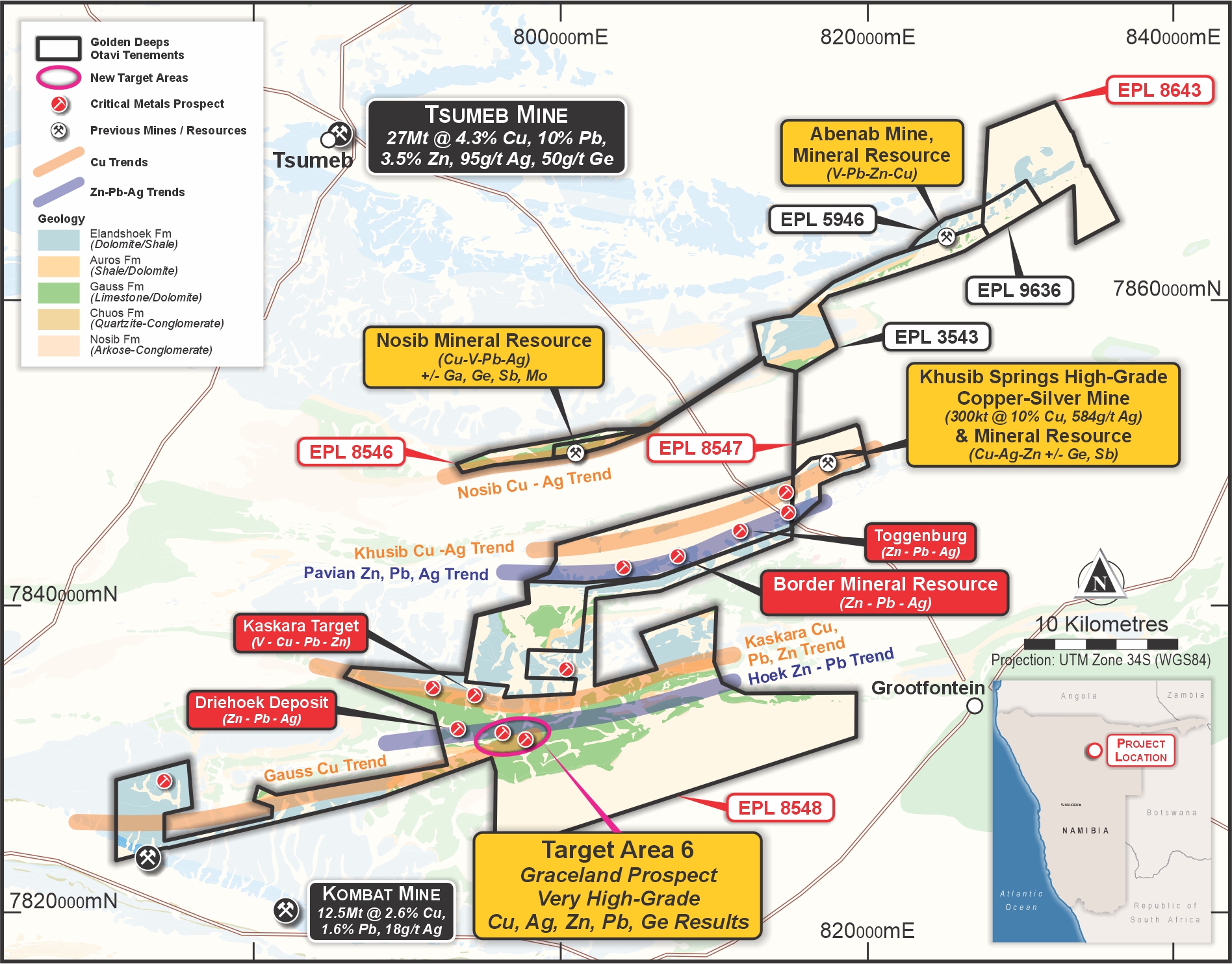
The Company has a series of brownfields polymetallic Copper-Lead-Zinc-Silver and Vanadium (+/- Gallium, Germanium, Antimony) projects in the world-class Otavi Mountain Land (OML) copper-lead-zinc-silver province of northern Namibia (see location, Figure 1).
The OML is a metallogenic province within the carbonate platform of the Neoproterozoic Damara Mobile Belt. It contains approximately 600 mineral occurrences including the major Tsumeb and the Kombat mines, with past production of:
- Tsumeb: 27 Mt @ 10% Pb, 4.3% Cu, 3.5% Zn, 95 g/t Ag, 50 g/t Ge (Mined)
- Kombat: 8.7 Mt @ 3.1% Cu, 1.1% Pb & 26 g/t Ag (Mined)
The mined deposits can be categorised into two distinct types:
- Primary sulphide deposits of the Tsumeb Cu-Pb-Zn-Ag Type and/or the Berg Aukus Zn-Pb-Ag type – generally hosted in carbonate rocks, and,
- Secondary supergene vanadium with zinc, lead and copper in vanadate oxide minerals (descloisite and/or mottramite) deposits, generally located in the vicinity primary sulphide deposits.
OML North includes the Abenab, Nosib and Khusib Springs projects, with Mineral Resources and high-grade mineralisation providing potential for critical metals including vanadium, gallium and germanium. At Nosib, high-grade gallium mineralisation occurs with Cu, V, Pb and Ag, with further metallurgical work planned.
Central Otavi, in which Golden Deeps holds an 80% interest, includes the Border Mineral Resource and the Driehoek and Kaskara projects. The Company’s current focus is the Graceland Cu-Ag-Zn-Ge Project, where high-grade Tsumeb-type mineralisation has been identified within the 800m Gossan 1 Corridor, with deeper drilling targeting extensions and additional sulphide targets.
OTAVI NORTH PROJECTS
Abenab Vanadium-Lead-Zinc Project
The Abenab Project is located at the northeastern end of EPL3543 and is centred on the historical Abenab mine, which operated as an open pit and underground mine from 1921 to 1947.
Historical production included 176,000 tonnes of high-grade concentrate grading 16% V₂O₅, 13% Zn and 54% Pb.
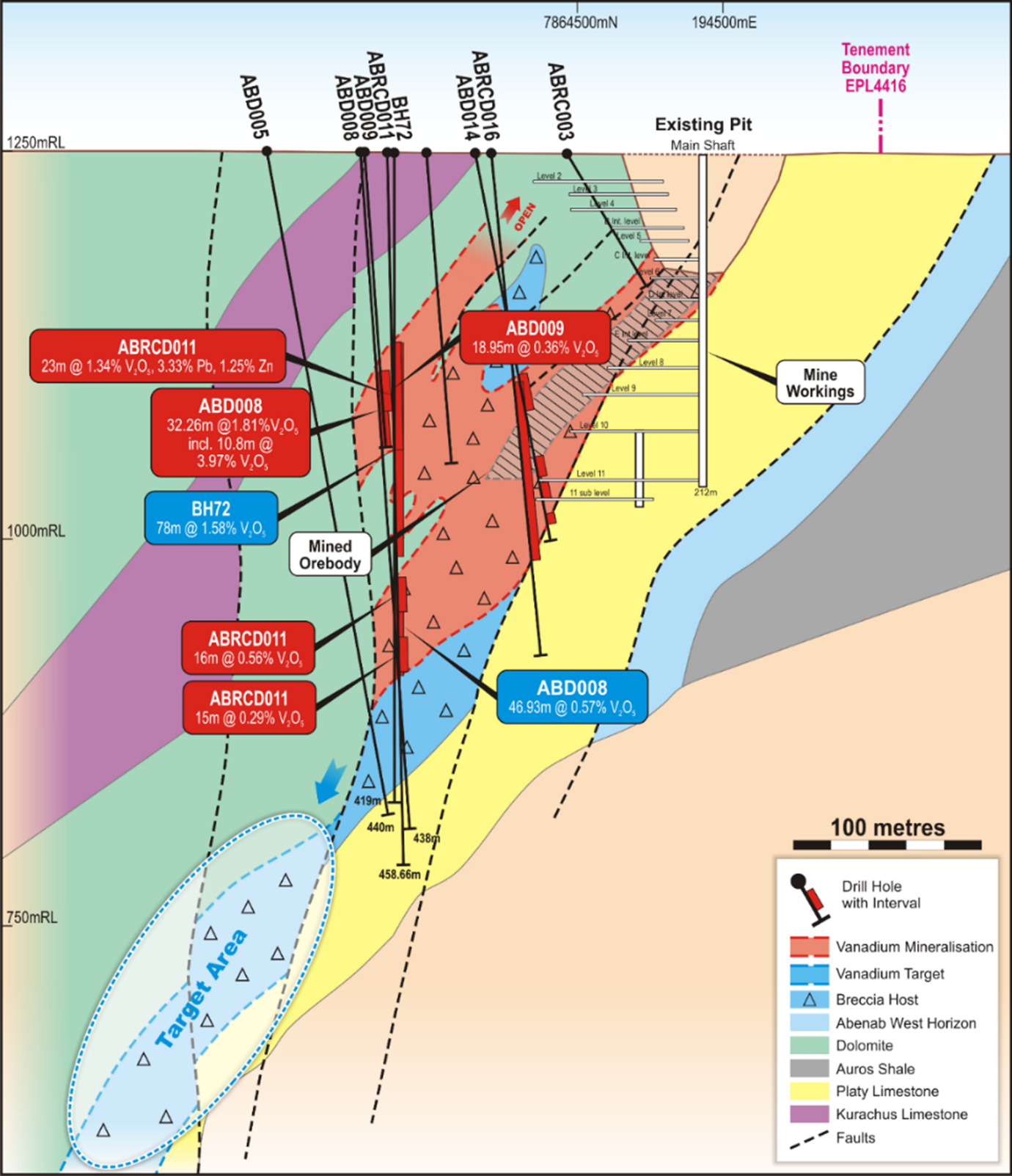
The Abenab mineralisation is hosted by carbonates of the Otavi Group and consists of a pipelike karst breccia of collapsed country rocks cemented by coarse calcite and descloizite-vanadinite concretions. The Abenab Breccia Pipe lies on a steeply dipping sheared contact between massive dolomite and platy limestone (see Figure 2, below).
The vanadium mineralisation at Abenab is contained in the minerals descloizite (vanadium-lead-zinc hydroxide) and vanadinite (vanadium-lead chlorovanadate). The vanadium mineralisation takes several forms including breccia clast infill, fine grained fracture fill, open space crystal growth and clay-filled cavities.
Metallurgical Testwork:
Metallurgical testwork on the Abenab mineralisation has focused on gravity concentration testwork to concentrate the high-density mineral descloisite. Several phase of testwork have been carried out, culminating in June 2023 with the generation of an exceptionally high-grade vanadium with zinc, lead and copper concentrate bulk-sample grading:
- 15.6% V2O5, 11.2% Zn, 38.2% Pb and 0.8% Cu
This represents an 18 times (x) upgrade of the representative drill-core composite sample, that had an assay head grade of 0.9% V2O5, 2.1% Pb and 0.7% Zn.
The Company has also carried out down-stream hydrometallurgical leach testwork which demonstrated vanadium extraction rates of up to 95% and high extraction of lead, zinc and copper from a lower grade concentrate feed generated from surface stockpiles and tailings.
Mineral Resource Estimate and Development Studies:
The outcomes of both the gravity concentrate testwork and the downstream hydrometallurgical testwork provided processing cost inputs (capital and operating) which were integrated into a new resource model for the Abenab deposit and an upgraded mining study (by Bara Consulting), to produce a scoping study for staged mining, gravity concentration and downstream processing of the high-grade Abenab high-grade V-Zn-Pb resource.
The new Mineral Resource estimate for the Abenab vanadium-lead-zinc deposit (announced 24 June 2024) was prepared by Shango Solutions of South Africa (Shango) and is summarised in Table 1 below:
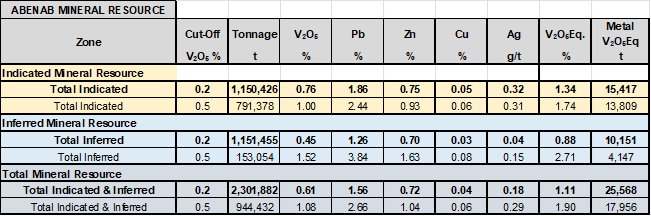
Shango also prepared the previous, January 2019, Mineral Resource estimate of 2.8Mt at 0.66% V2O5, 2.35% Pb and 0.94% Zn (0.2% V2O5 cut-off), which utilised historical drilling by Avonlea Minerals Ltd.
The new Mineral Resource estimate follows further drilling by GED in 2019 which included 18 RC and diamond drillholes for 3,266m which was designed to infill and extend definition of the Inferred Mineral Resource areas identified in the 2019 model. During late 2022 to early 2023 Shango updated the Abenab model in Datamine (all previous models were created in Leapfrog Geo) incorporating the 2019 drilling results for the purposes of refining and optimising the wireframes and block models.
Mining studies by Bara Consulting of South Africa and metallurgical gravity concentration and hydrometallurgical leaching testwork provided economic parameters to determine cut-off grade parameters for the reasonable prospects of economic extraction determination.
Underground mining studies on the Abenab Mineral Resources and an open pit mining study on the Nosib Mineral Resource, in progress, are being integrated with the metallurgical/processing studies, to produce a development study (the Study) for the production of high-grade vanadium-copper-lead-zinc-silver concentrate. The Company’s testwork has shown that the concentrate can be downstream processed by acid leaching to produce high-value vanadium products such as vanadium electrolyte for vanadium redox flow batteries (VRFBs) as well as copper, lead, zinc and silver by-products.
Nosib Vanadium & Copper, Lead-Zinc-Silver Prospect
The Nosib prospect is located at the western end of the Company’s EPL3543 (Figure 1), 20km southwest of Abenab. Nosib is a new discovery that has produced a number of exceptional, thick and high-grade, vanadium-copper-lead-silver RC and diamond drilling intersections over the last 12 months.
The Nosib mineralisation is hosted by an arenaceous to conglomeratic unit which is poorly exposed and lies at the base of the Damara sedimentary sequence, overlain by the dolomitic units that host the majority of the base metal mineralisation in the OML.
Drilling has identified and defined two distinct zones of mineralisation at Nosib (Figure 3):
- A shallow, high-grade, vanadium-copper-lead-silver supergene enriched zone that has produced a series of high-grade intersections of copper, vanadium and lead with silver including:
- 53.52m @ 1.15% Cu, 0.62% V2O5, 3.49% Pb, 4.57 g/t Ag from surface in NSBDD008 incl. 11.74m @ 2.67% Cu, 1.42% V2O5, 9.21% Pb, 7.12 g/t Ag.
- 45.70m @ 1.0% Cu, 0.72% V2O5, 2.8% Pb, 4.00 g/t Ag from surface in NSBDD002 incl. 12.10m @ 3.2% Cu, 2.54% V2O5, 9.8% Pb, 8.0 g/t Ag, and,
2. A thick, stratabound, copper-silver sulphide zone at depth that has produced significant true-width intersections of sulphide mineralisation up to 45m thick, across the entire thickness of the northerly dipping arenite/conglomerate host unit, including in NSBDD003:
- 44.54m @ 0.38% Cu, 3.6 g/t Ag from 62.3m incl. 11.10m @ 0.70% Cu, 5.6 g/t Ag
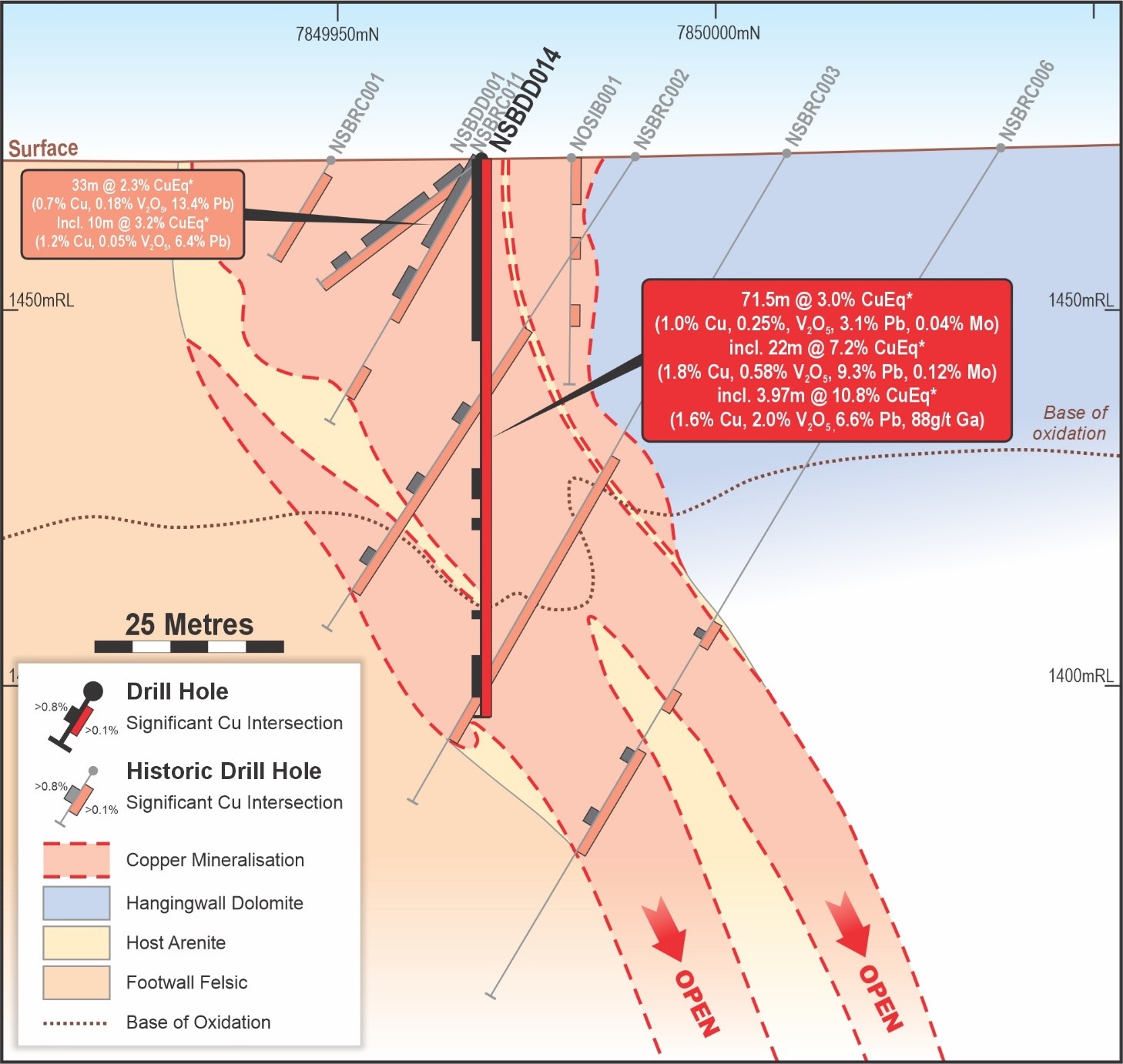
More recent drilling (2023) on step-out sections to the west of the previously drilled deposit extended the copper-silver stratabound sulphide deposit to the west and at depth. The most westerly intersection in the recent diamond drilling program intersected 44.22m @ 0.6% CuEq* (0.50% Cu, 3.2 g/t Ag) from 34.8m in NBSDD007 and included a massive sulphide zone of 0.49m @ 10.3% Cu, 56.9 g/t Ag (Figure 4 & 5). Further drilling is planned to extend this zone, to target a substantial stratabound Cu-Ag sulphide resource.
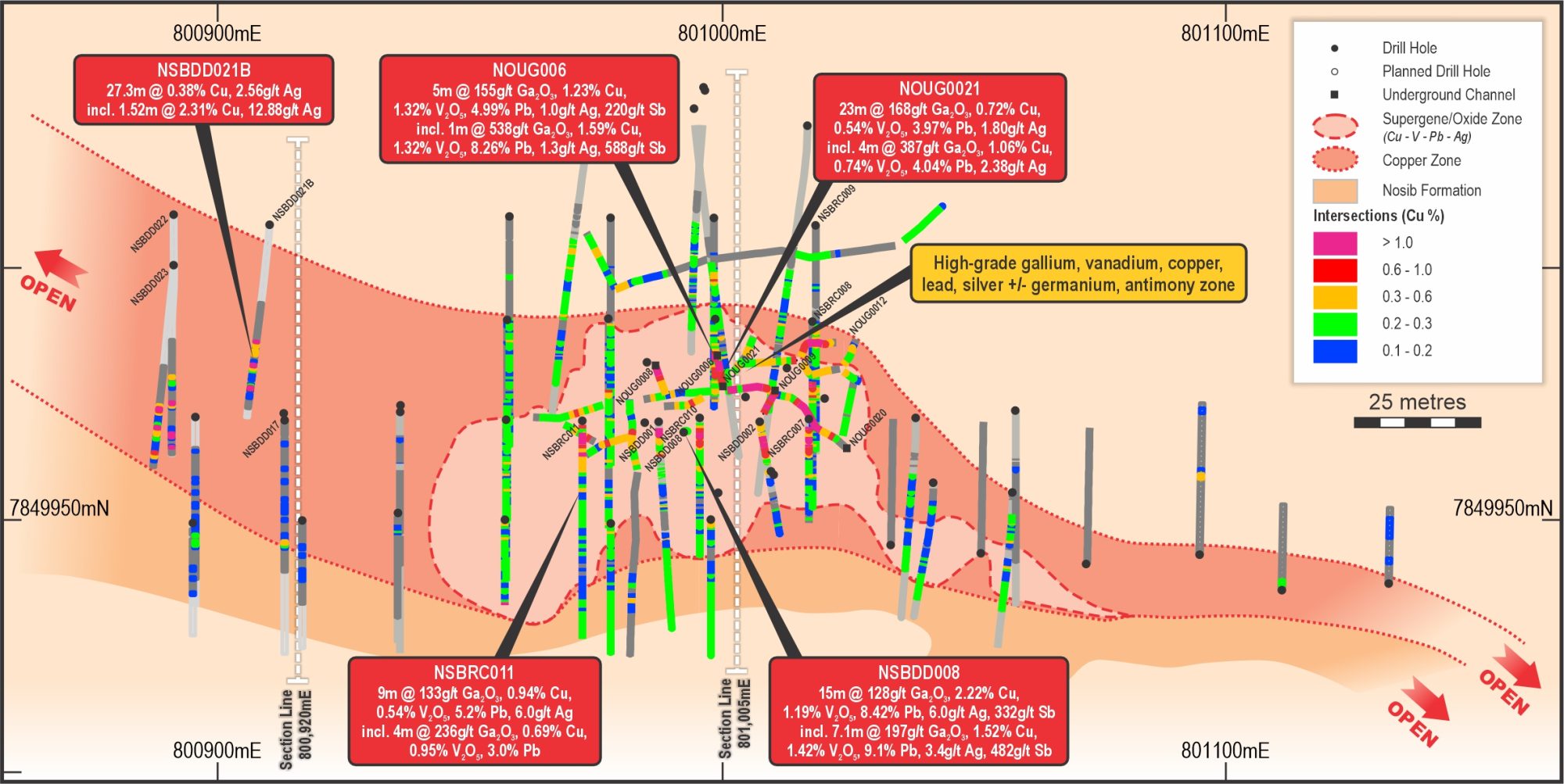
In addition, a recent review of historical underground channel sampling and previous drilling results at the Company’s Nosib Prospect in Namibia has identified further high-grade gallium (Ga) with copper (Cu), vanadium (V2O5), lead (Pb), silver (Ag) and highly-anomalous germanium (Ge) and antimony (Sb) (see Figure 1).
High-grade gallium (>100g/t gallium trioxide, Ga2O3) intersections identified include:
- 23m @ 168 g/t Ga2O3, 0.72% Cu, 0.54% V2O5, 3.97% Pb, 1.8 g/t Ag from 4m, NOUG0021
- 23m @ 135 g/t Ga2O3, 1.83% Cu, 1.91% V2O5, 7.3% Pb, 6.7 g/t Ag from 0m, NOUG0020
- 5m @ 155 g/t Ga2O3, 1.23% Cu, 1.32% V2O5, 4.99% Pb, 1.0 g/t Ag, 220 g/t Sb from 1m, NOUG0006
- 15m @ 128 g/t Ga2O3, 2.22% Cu, 1.19% V2O5, 8.42% Pb, 6.0 g/t Ag, 332 g/t Sb from 0m, NSBDD008
The high-grade gallium (with Cu, V2O5, Pb, Ag +/- Ge, Sb) intersections occur from surface to 50m depth (see Figure 2) and are associated with the vanadium, copper, lead and silver enriched oxide/saprolite zone. This zone remains open to the east and west where there is potential for further drilling to expand.
Gallium is a critical metal in high demand for its superior performance in high-speed semiconductor chips, LEDs and solar cells. About 98% of global production comes from China, which imposed export restrictions on gallium (and germanium) in mid-2023. This has restricted supply and driven pricing.
The Company will re-evaluate the potential for gallium, germanium and antimony at its other Namibian prospects, including Abenab and Khusib Springs (Ge and Sb previously reported) and on its newly-acquired Central Otavi Project including at Kaskara, where germanium has been reported (see Figure 4). Further sampling and analysis then drilling of selected targets is planned.
Nosib Mineral Resource Estimate and Development Studies:
Mineral Resource modelling and estimation has been carried out by Shango Solutions. The Nosib mineralisation includes a supergene vanadium-copper-lead-silver zone which has been drill defined at 10m to 20m spacing with RC and diamond drilling over a 100m strike length and to approximately 80m vertical depth (Figures 4 & 5).
The supergene mineralisation at Nosib includes the secondary vanadium minerals descloisite and mottramite. Descloisite is the same lead-zinc-vanadium hydroxide mineral that occurs at Abenab and Mottramite is a copper-lead vanadium hydroxide. Metallurgical testwork shows that these minerals respond very well to gravity concentration. Metallurgical gravity concentrate testwork on two bulk samples (drill core and surface samples) of the Nosib mineralisation has produced two high-grade gravity concentrate samples. The combined grade of the concentrate below represents a 5-times upgrade of vanadium and other critical elements:
- 4.5% V2O5, 5.9% Cu, 18.9% Pb, 0.11% Mo, 12g/t Ag, 437 g/t Sb, 107g/t Ga, 17g/t Ge, 354 g/t TREO
Metallurgical recoveries to gravity concentrate range up to 71% for vanadium. Further, ongoing testwork on the high-grade concentrate will include hydrometallurgical leaching to optimise recovery of high-value vanadium products, as well as copper, lead and other critical and rare metal by-products such as molybdenum, antimony, gallium, germanium and potentially HREEs.
The Maiden Mineral Resource estimate for the Nosib copper-vanadium-lead-zinc-silver discovery (released 24 June 2024) was prepared by Shango Solutions of South Africa (Shango) and is summarised in Table 2 below:
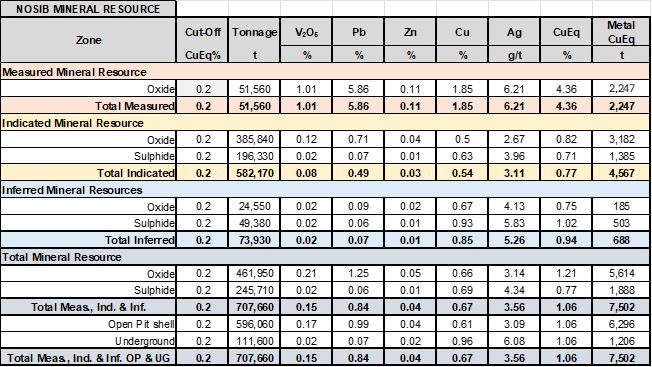
The Mineral Resource estimates for copper (Cu), lead (Pb), vanadium (V2O5), zinc (Zn) and silver (Ag) were performed in accordance with The Australasian Code for Reporting of Exploration Results, Mineral Resources and Ore Reserves (JORC, 2012). Shango verified and prepared the Golden Deeps database for 3-d modelling and Mineral Resource estimation by means of applying industry best practices.
The drill-defined Nosib deposit includes stratiform sulphide copper-silver mineralisation hosted by the Nosib Group arenites and diamictite/conglomerate, which underlies the carbonate units of the Tsumeb and Abenab sub-groups and hosts the majority of the mineral deposits in the Otavi region.
Overprinting the sulphide deposit is a supergene-oxide zone of vanadium-copper-lead-zinc-mineralisation which represents the majority of the Mineral Resources estimated from surface to approximately 80m vertical depth.
The open-pit Mineral Resource estimates were generated via an optimised pit shell (60-degree slope) and declared on the basis of reasonable prospects of eventual economic extraction.
In addition to the open pit Mineral Resources, underground Mineral Resources have also been declared, which are open to the west and at depth and represent a stratiform Cu-Ag sulphide target for further drilling, targeting underground Mineral Resources sufficient to support an underground development (Figures 4 & 5).
The maiden Mineral Resource model for the Nosib deposit will be combined with the updated Mineral Resource model and mining studies on the Abenab high-grade vanadium (Zn, Pb) deposit, to produce an integrated mining and processing Scoping Study for the production of vanadium with copper, lead, zinc and silver and potentially other valuable by-products such as molybdenum, germanium, gallium and HREEs. The results of the Scoping Study will be reviewed before further exploration to increase available Mineral Resources is considered and/or the study is upgraded to a PFS following further metallurgical testwork.
Khusib Springs Copper-Silver-Zinc Deposit
The Khusib Springs Mine was a high-grade mine located in the Otavi Mountain Land near Grootfontein in Northern Namibia (Figure 1). The deposit was discovered early in the 1990s through mapping and drilling and went into production in 1995. The deposit is a steeply plunging pipe-like lens hosted by limestone and is considered to be analogous with the Tsumeb Mine 40km to the northwest. Approximately 300,000t at 10% Cu, 584g/t Ag and 1.8% Pb was mined from the deposit. Khusib Springs has a similar geological setting to Tsumeb.
A Mineral Resource model is also being prepared for the Khusib Springs high-grade copper-silver deposit. The Company’s diamond drilling programs below an interpreted off-settign fault identified wide zones of copper-silver mineralisation below the previously mined zone. Results included a 90m copper-silver intersection grading 0.8% CuEq* (0.3% Cu, 52.3 g/t Ag, 0.06% Zn, 34.4 g/t Sb) from 389m downhole in KHDD006, including 28m @ 1.5% CuEq* (0.5% Cu, 101 g/t Ag, 0.1% Zn, 80.8 g/t Sb) from 402m (see Figure 5).
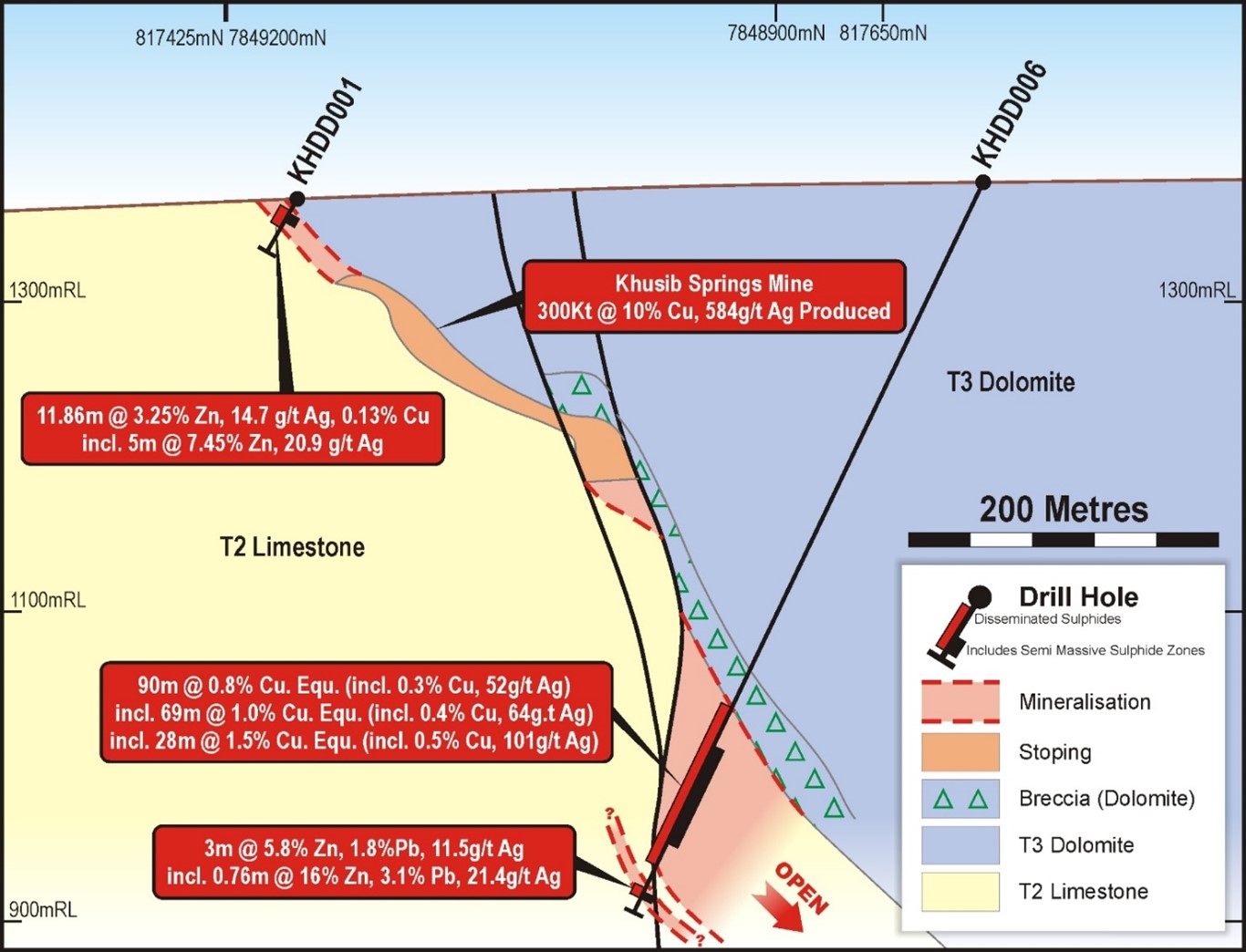
Shango are currently modelling this thick mineralised zone to determine Mineral Resource potential and identify targets for further drilling.
OTAVI CENTRAL PROJECTS
Border Zinc-Lead-Silver Deposit
The Border deposit is part of the >10km strike-length Pavian Zinc-Lead-Silver Trend which includes several other Zn-Pb-Ag prospects including Toggenberg, 2km east of Border, and Nosib H to the west (see Figure 6).
Previous and historical reverse circulation (RC) and diamond drilling has defined a stratabound dolomite hosted zinc-lead-silver sulphide deposit at Border over a 2.4km strike-length and to 300m below surface. The mineralisation is made up of thick northwest dipping lenses up to 85m thick, averaging 25m thickness, and dipping steeply to the southeast.
Previous intersections from Border include:
- 101m @ 2.12% Zn + Pb (1.45% Zn, 0.69%Pb), 5.68 g/t Ag from 18m in BDRC0032D
- 45m @ 2.10% Zn + Pb (1.48%Zn, 0.62% Pb), 3.81 g/t Ag from 101m in BDDD0049
A JORC 2012 Inferred Mineral Resource has been estimated for Border as follows:
- 16.2 Mt @ 2.12% Zn + Pb (1.53% Zn, 0.59% Pb) & 4.76 g/t Ag (1.25% Zn + Pb cut-off)
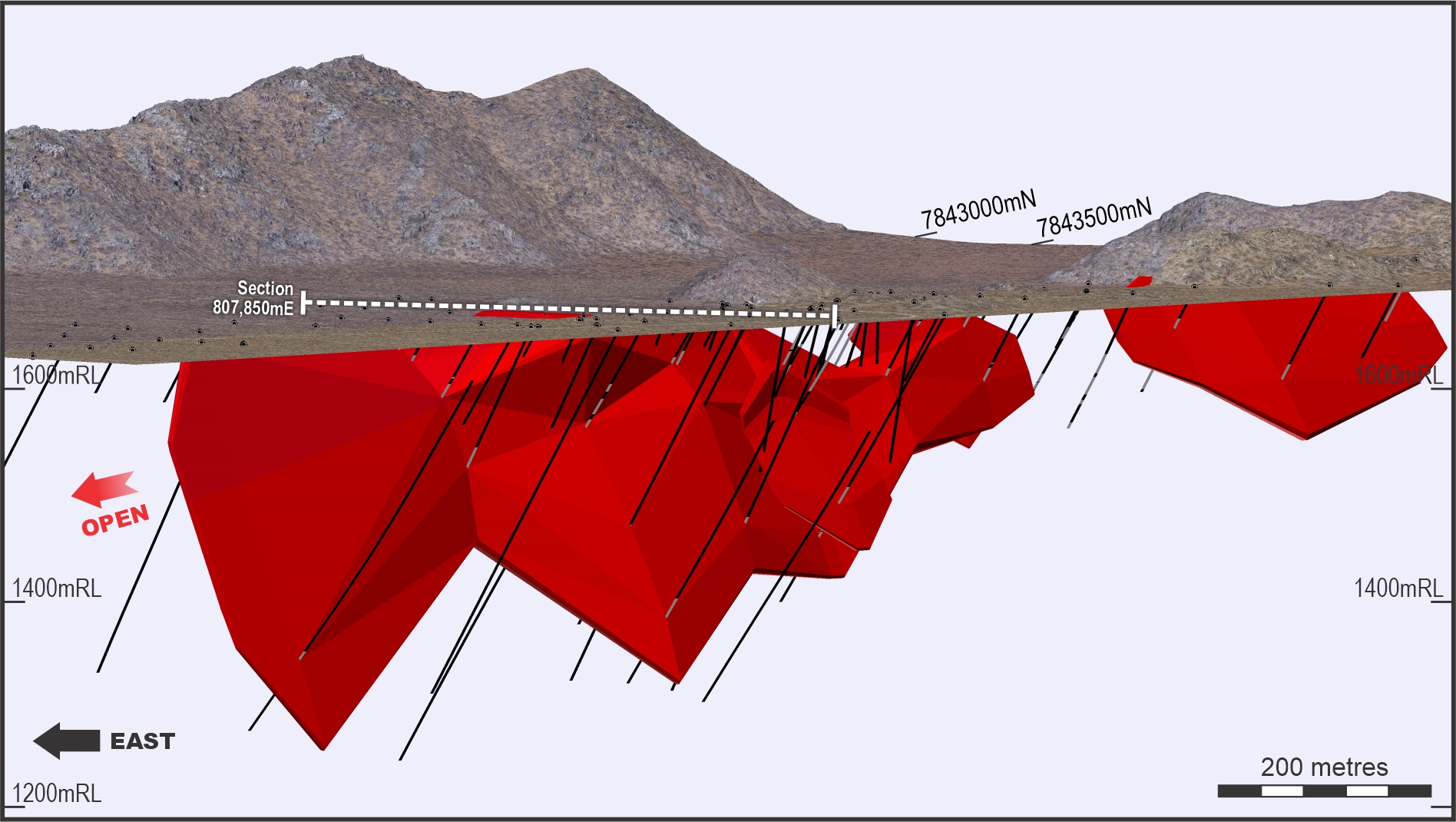
The Border deposit is open to the east where there is potential to extend the Mineral Resource through further drilling. Previous very shallow geochemical drilling defined a large Zn + Pb anomaly in an area of cover at Toggenburg Zn-Pb prospect, located about 2km along strike to the east of Border.
Other target areas for resource growth along the Pavian Trend include the South Ridge Zn-Pb-Ag and Cuprospect, located 4km east of Border (see Figure 1). Other prospects to the west of Border (e.g. Nosib H) show potential for zinc-lead-silver as well as copper mineralisation and will be investigated further.
Driehoek Zinc-Lead-Silver Deposit
The Driehoek Zinc-Lead-Silver deposit is an advanced exploration prospect located on the Hoek trend in the central part of the Central Otavi Project (see Figure 1). Driehoek deposit includes three outcropping carbonate hosted Zn-Pb-Ag mineralised zones at Driehoek North, Driehoek Central and Driehoek East (see Figure 7).
The North and Central deposits are partially weathered sulphide (sphalerite and galena) deposits with secondary oxide minerals present. Historical trenching intersections included:
- 103m @ 5.96% Zn+Pb (4.50% Zn, 1.46% Pb), 5.85 g/t Ag in trench DKCS004, and,
- 68m @ 3.76% Zn+Pb (3.31% Zn, 0.45% Pb), 1.94 g/t Ag in trench DKCS006, incl 6m @ 17.89% Zn+Pb (16.41% Zn, 1.48% Pb), 8.5 g/t Ag & incl.12m @ 11.51% Zn+Pb (8.54% Zn, 2.97% Pb), 2.12 g/t Ag
Historical diamond drilling intersections included thick intersections from Driehoek East (see Figure 7 for location). These holes intersected a pipe-like mineralised body which has the potential to continue at depth and include:
- 61.85m @ 4.21% Zn+Pb (2.96% Zn + 1.25% Pb) & 6.30g/t Ag from 12.4m in DKDD0008 incl. 2m @ 12.1% Zn + Pb (10.07% Zn + 2.03% Pb), 11.9 g/t Ag from 18.9m & 3m @ 13.8% Zn + Pb (7.90% Zn + 5.88% Pb), 27g/t Ag from 54m.
- 71m @ 3.6% Zn + Pb (2.63% Zn + 1.00% Pb) & 4.75g/t Ag from 10min DKDD0009 incl. 4m @ 11.4% Zn + Pb (7.26% Zn + 4.17% Pb) & 22.75g/t Ag from 18m & 9m @ 7.6% Zn + Pb (5.71% Zn + 1.90% Pb), 9.52g/t Ag from 28m
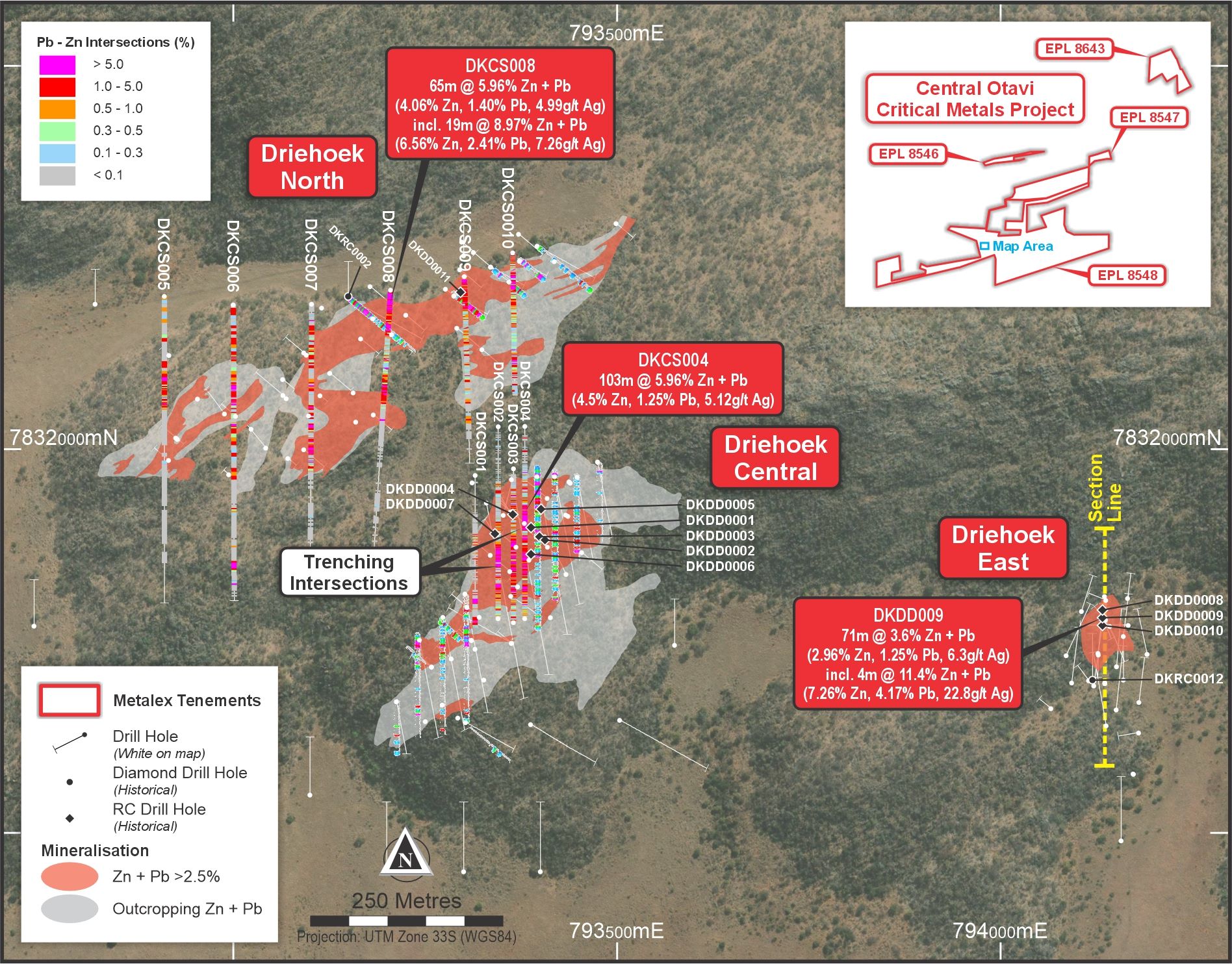
The Driehoek deposit has the potential to generate significant, at surface, Zn-Pb-Ag Mineral Resources. Verification of historical data and metallurgical testwork is required, as well as check drilling in key areas. Extensions of the deposit will also be targeted.
Kaskara Vanadium-Copper-Lead-Zinc (Germanium) Prospect
The Kaskara advanced exploration prospect includes high-grade vanadium with lead, zinc and copper associated with vanadate minerals in breccia pipes and lenses at surface.
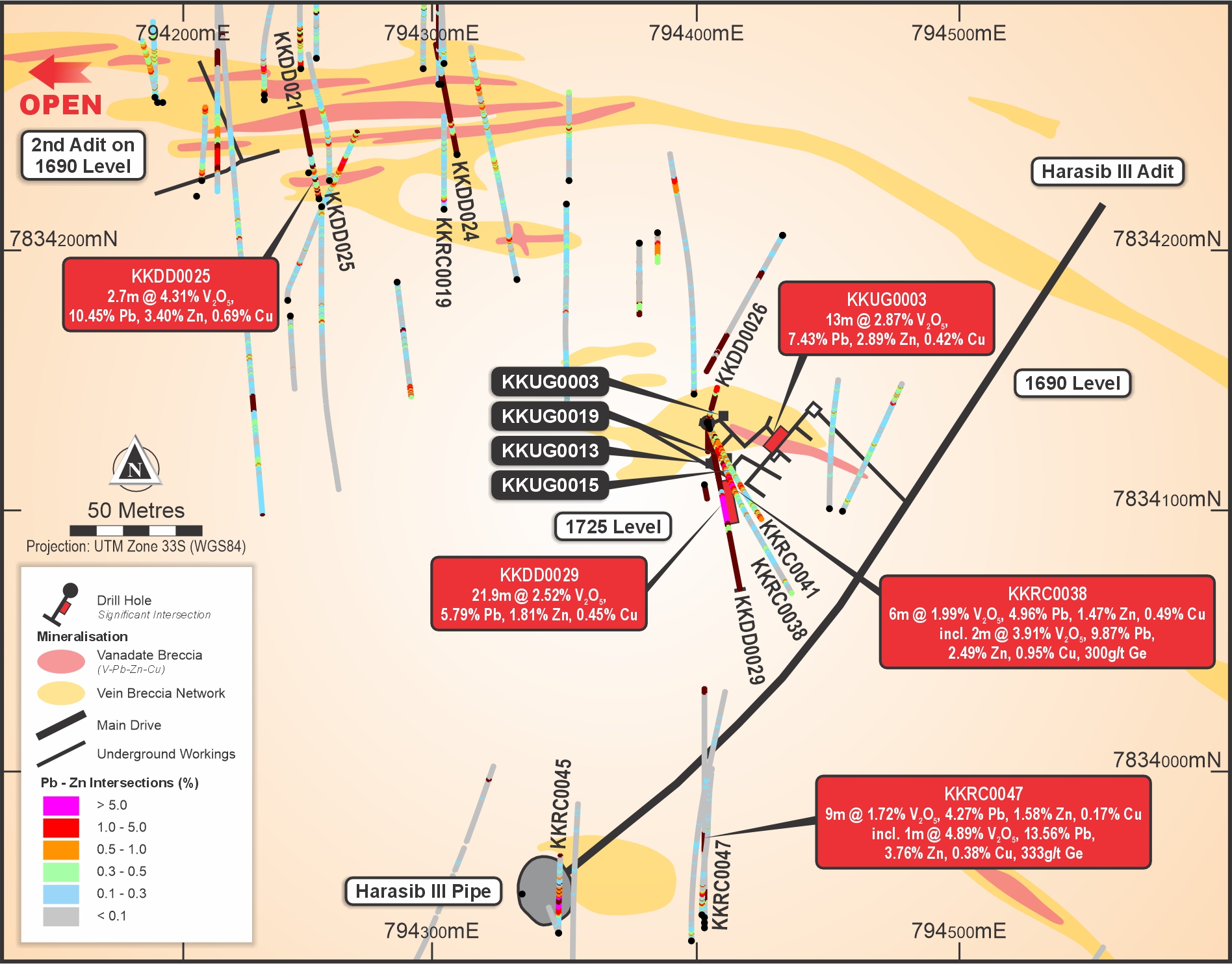
The breccia hosted mineralisation includes a 300m strike length zone at the northwestern end of the prospect which includes multiple mineralised breccia lenses (see Figure 8). Previous RC and diamond drilling of this zone produced several high-grade intersections which included:
- 2.7m @ 4.31% V2O5, 10.45% Pb, 3.40% Zn & 0.69% Cu from 0m, KDD0025
Other pipe-like breccia deposits southeast of this zone include the Harasib III pipe (see Figure 8). Previous drilling of this zone produced significant intersections including:
- 21.9m @ 2.52%V2O5, 5.79% Pb, 1.81% Zn & 0.45% Cu from 53.96m, KKDD029
Previous drilling also included germanium values of up to 1m @ 333 g/t Ge (4.89% V2O5, 13.6% Pb, 3.76% Zn, 0.38% Cu) from 29m in KKRC0047 and 2m @ 300 g/t Ge (3.91% V2O5, 9.87% Pb, 2.49% Zn, 0.95% Cu) from 64m in KKRC0038.
Immediate exploration will include soil and rockchip sampling and multi-element laboratory analysis of the vanadate breccias to test for enrichment of other critical metals e.g. Ga and Ge. This will be followed by selective drill targeting of the breccias in areas of inadequate testing or excessive core loss.
In addition, a previous induced polarisation (IP) survey detected two large low resistivity anomalies at depth. The IP anomalies could be sulphide deposits at depth below the V-Pb-Zn-Cu bearing breccias which will be assessed for drill testing.
‘Tsumeb-type’ Target Areas
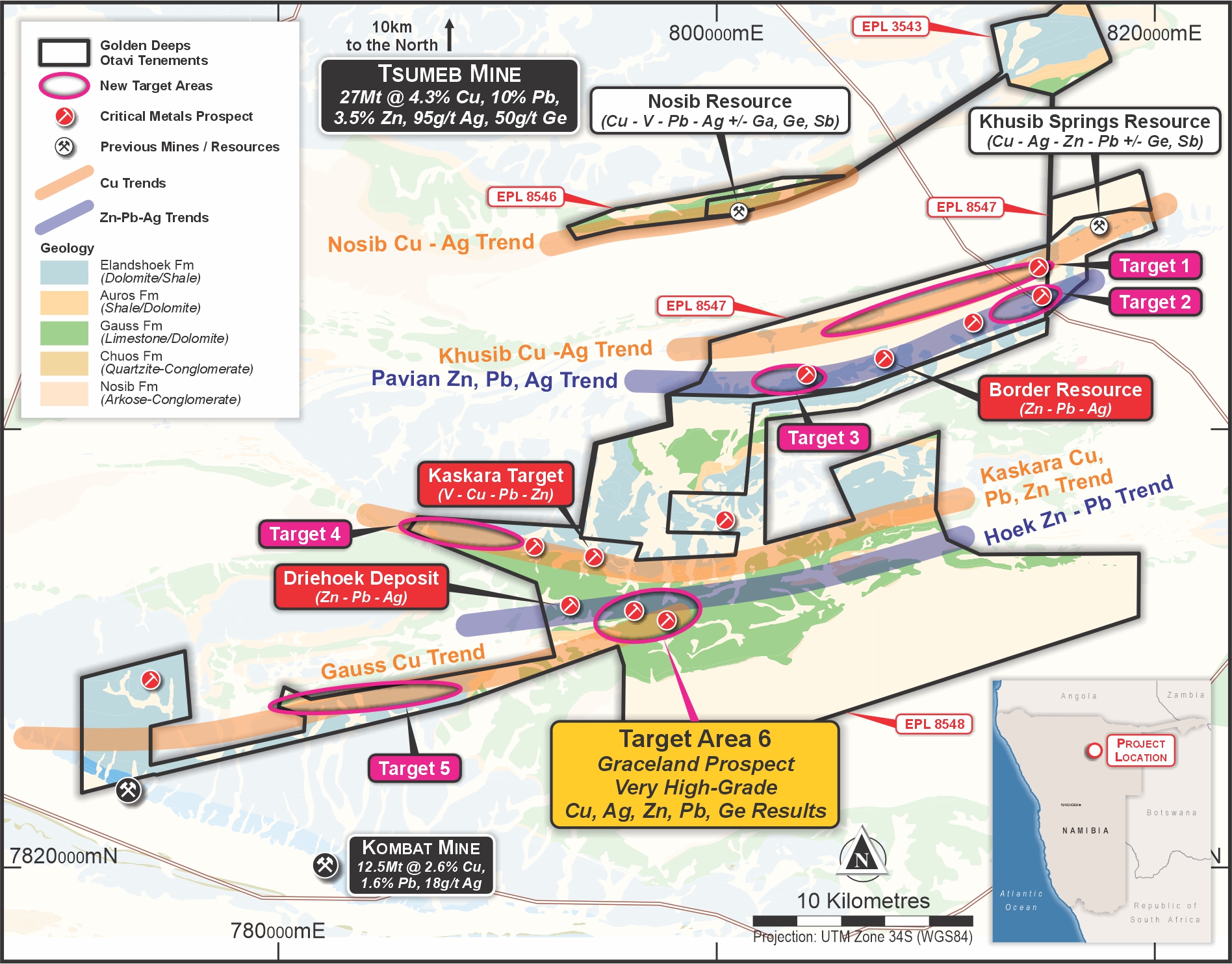
Potential has been identified for ‘Tsumeb-type’ Cu-Pb-Zn-Ag (+/-Ga, Ge,Sb) mineralisation in several areas on the Central Otavi Project.
Historical soil sampling carried out across the Central Otavi properties was not fully documented in terms of sampling methodology and analysis of samples was predominantly by portable XRF (pXRF). Only copper, lead, zinc, manganese and vanadium results were recorded.
Target areas of interest identified by the historical soil sampling will be the focus of initial follow-up sampling to verify previously identified soil and/or rock-chip anomalies and analyse for a full suite of elements (including Ga, Ge, Sb, Ag which were not previously recorded) by ICP-OES/MS.
Follow-up rock-chip/channel sampling and geophysical programs (IP or EM) will be utilised to define targets for drilling.
Graceland Prospect
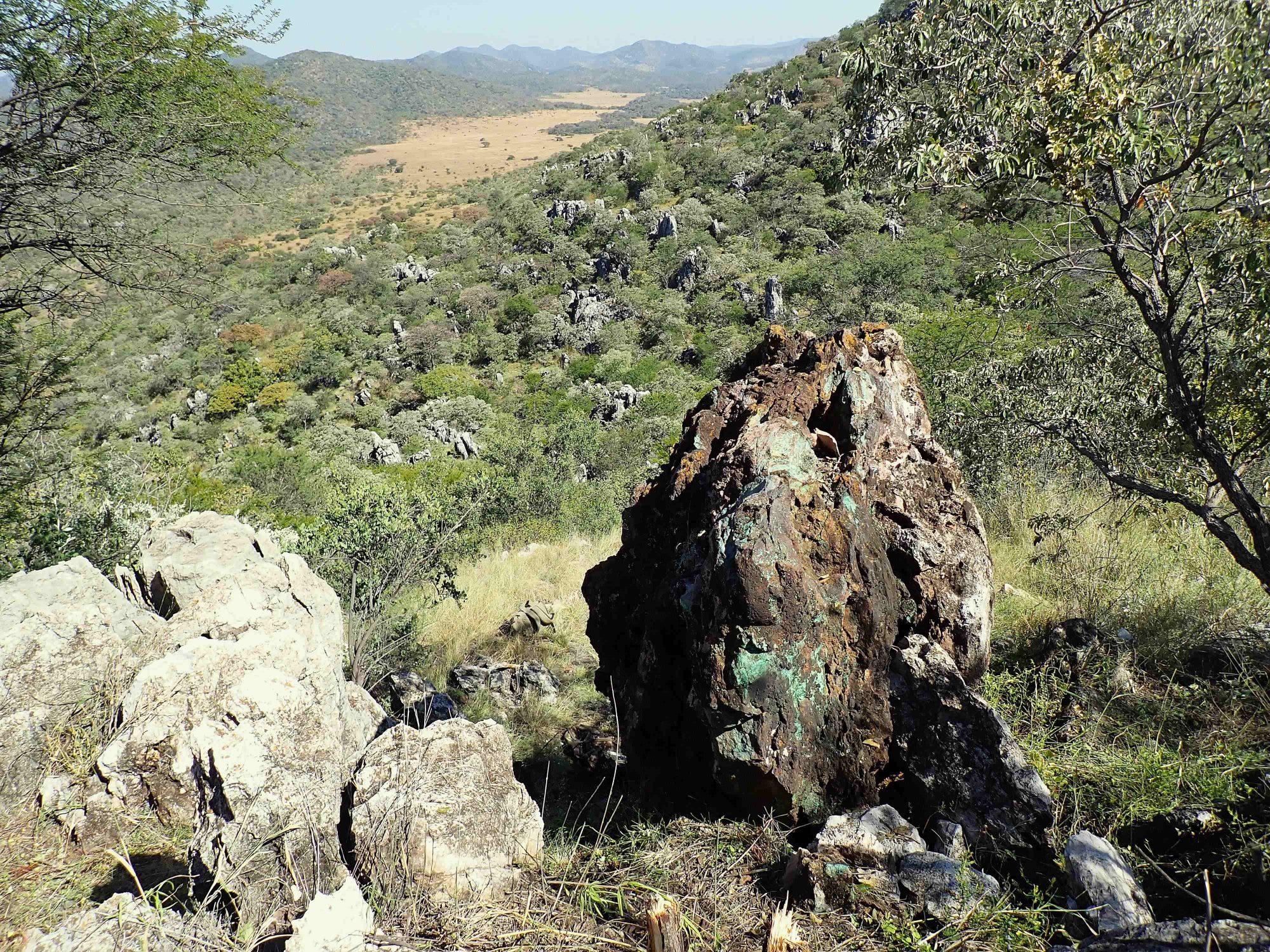
The initial area sampled, Target Area 6 (now named Graceland Prospect, see Figure 10), has produced exceptional copper, silver, zinc, lead and germanium results from rockchip sampling of multiple gossan and sulphide occurrences. These outstanding results are from a large, mineralised corridor, now defined by highly anomalous Cu-Zn-Pb-Ag soil sampling results over 2km in a northeast-southwest direction and over 1km wide in a northwest-southeast direction.
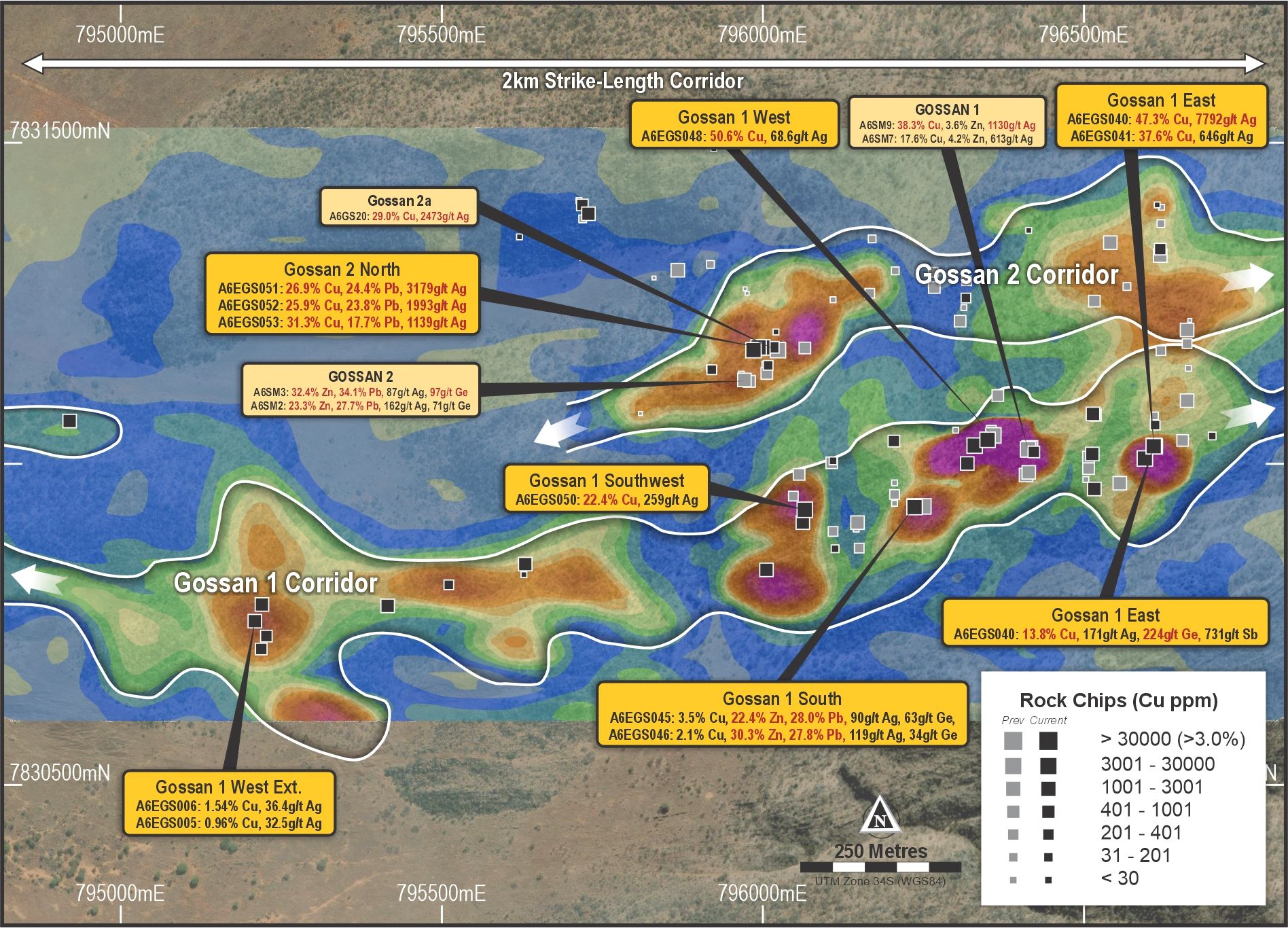
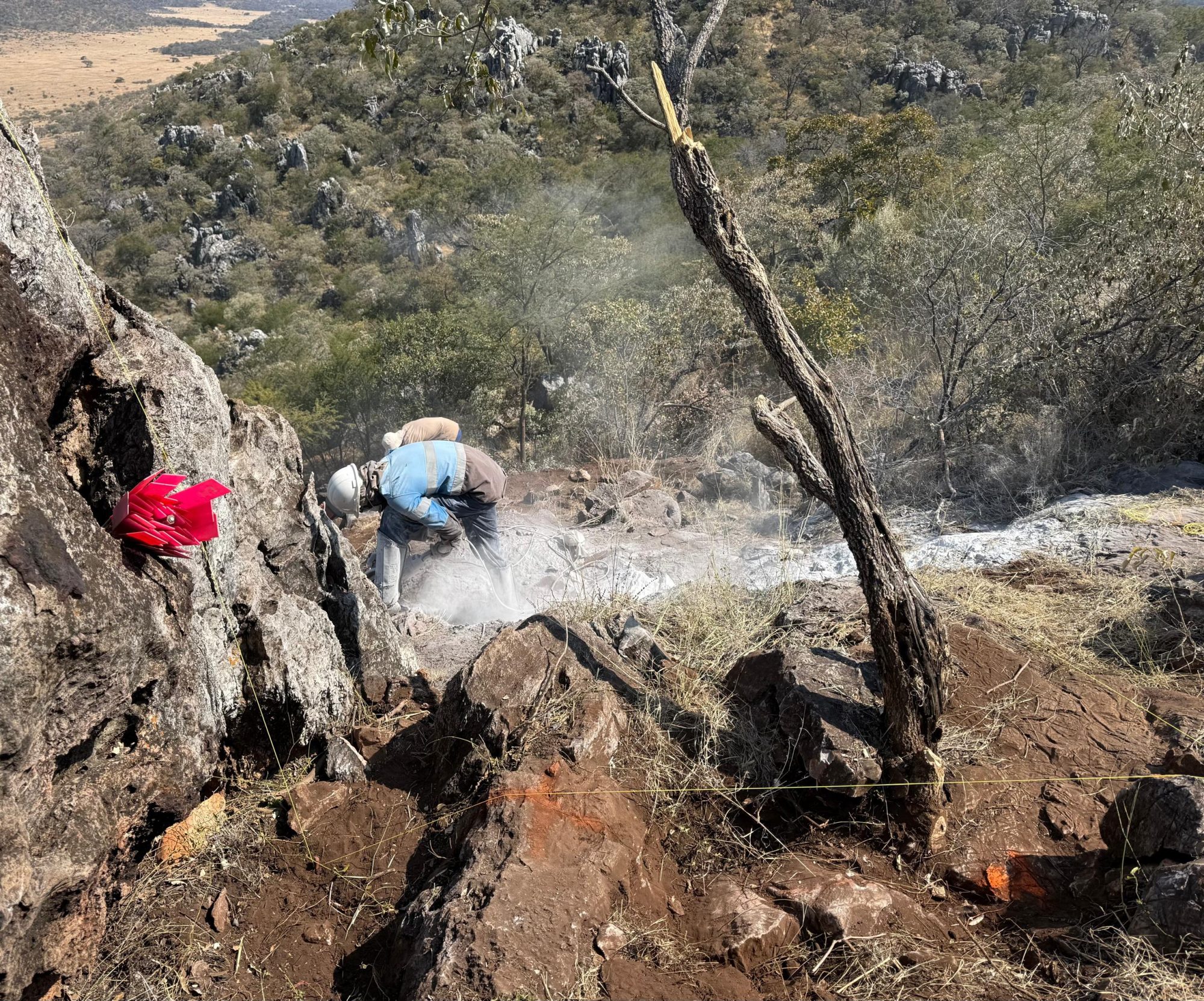
Trenching and channel sampling has been completed across the most significant gossan and sulphide outcrops, and geophysical programs are planned to define drilling targets for multiple “Tsumeb-like” high-grade Cu, Ag, Zn, Pb, Ge (+/- Sb, Ga) bearing sulphide discoveries.
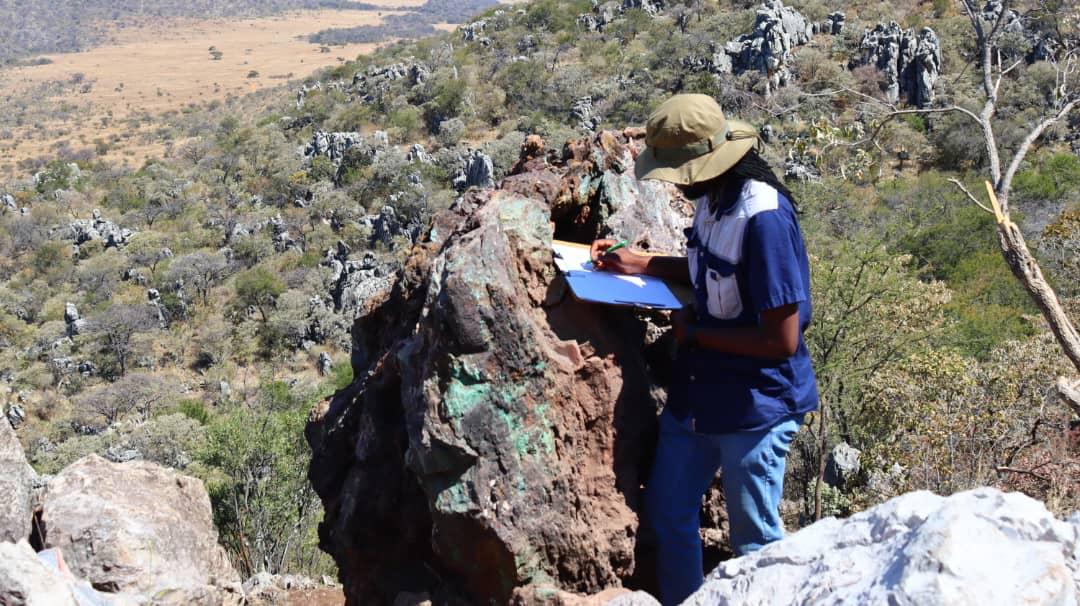
Chief Geologist, Elvis Akawa