Lachlan Fold Belt, NSW
Lachlan Fold Belt Copper-Gold & Silver Projects
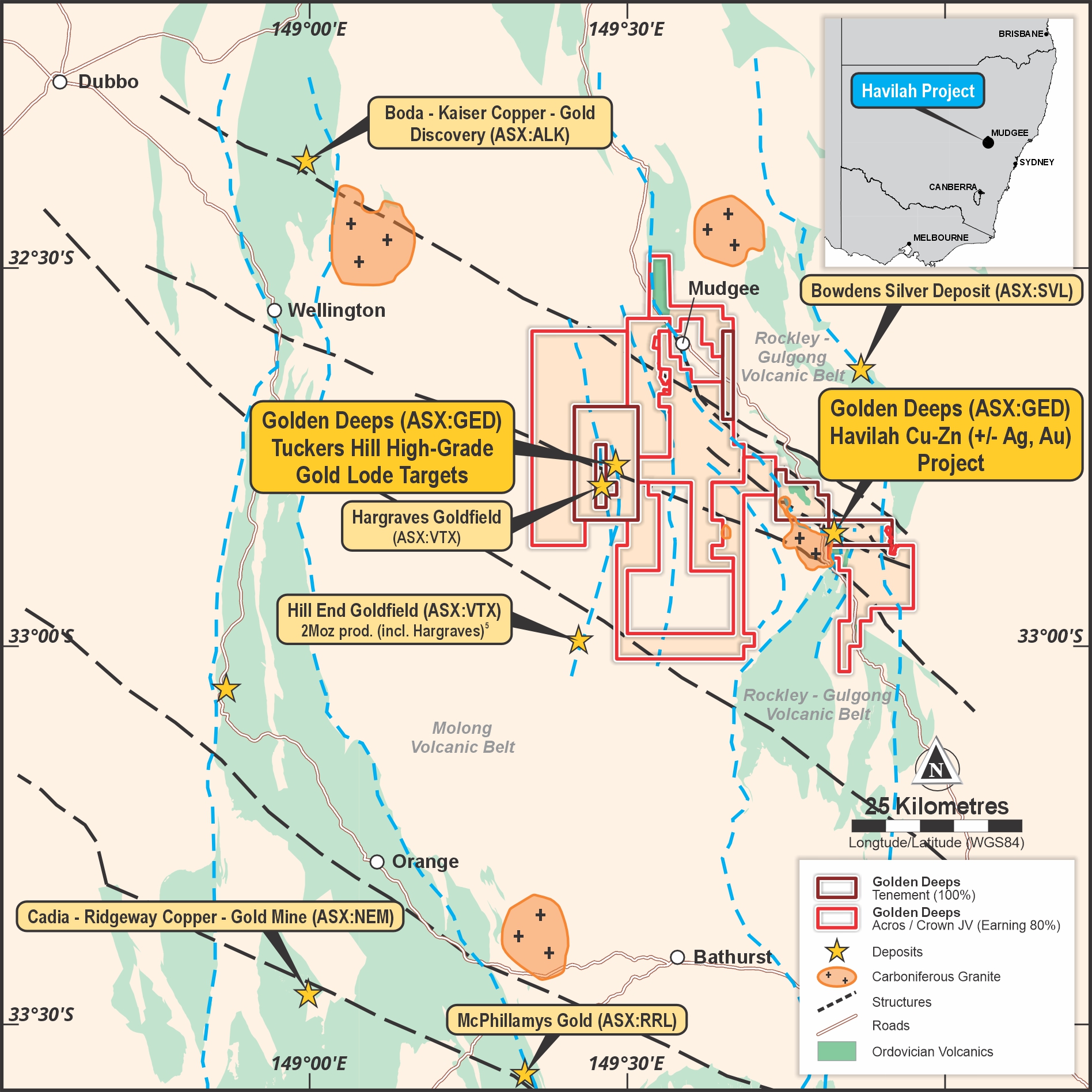
Golden Deeps has extensive tenements covering over 600km2 in the eastern Lachlan Fold Belt copper-gold province in New South Wales (Figure 1). The Lachlan Fold Belt is a high-profile mining and exploration region that contains several major gold, copper-gold and silver deposits. These include Newcrest Mining Ltd’s Cadia-Ridgeway Mine, Evolution Mining Ltd’s Lake Cowal Mine, China Molybdenum Co. Ltd’s North Parkes Mine, Alkane Resources Ltd’s Tomingley mine, and Silver Mines Ltd’s Bowdens deposit.
The Company’s tenements include the Havilah Project, the Tuckers Hill Project and the Acros and Crown JV tenements, which are located on the eastern margin of the Lachlan Fold Belt and straddle the boundary between the Siluro-Devonian Hill End Trough – which contains the Hill End gold field (2Moz produced), and the Rockley-Gulgong Volcanic Belt which is the eastern of four Ordovician volcanic belts and is highly prospective for porphyry related copper-gold deposits (see regional map, below).
Havilah Copper-Zinc (Au, Ag) Project & Acros-Crown JV
At the Havilah Project (EL8936) the Company is targeting porphyry/volcanic hosted copper-gold mineralisation in a belt of Ordovician age (Sofala) volcanic rocks in the under-explored Rockley-Gulgong Volcanic Belt.
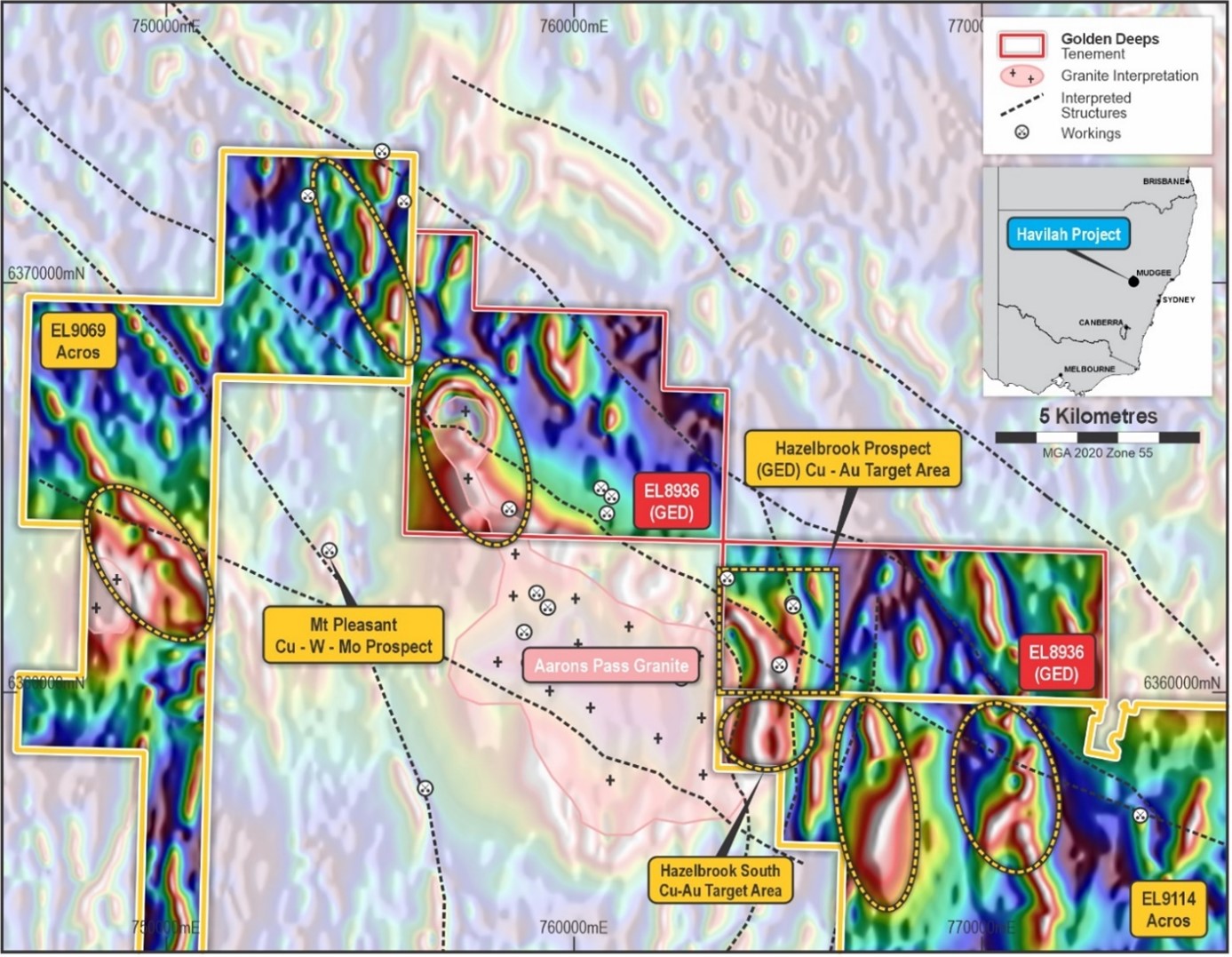
Mineralisation occurs on the Havilah tenement at the historical Milfor and Cheshire copper workings, within altered Sofala Volcanics that contain pyrite and chalcopyrite. Extensive stream sediment copper anomalism occurs across the northeastern margin of the Aarons Park batholith, which outcrops immediately to the southwest of the Havilah tenement. This granitic intrusion is associated with porphyry Mo-W-Cu mineralisation west of the Havilah tenement at the Mt Pleasant Prospect (see Figure 2).
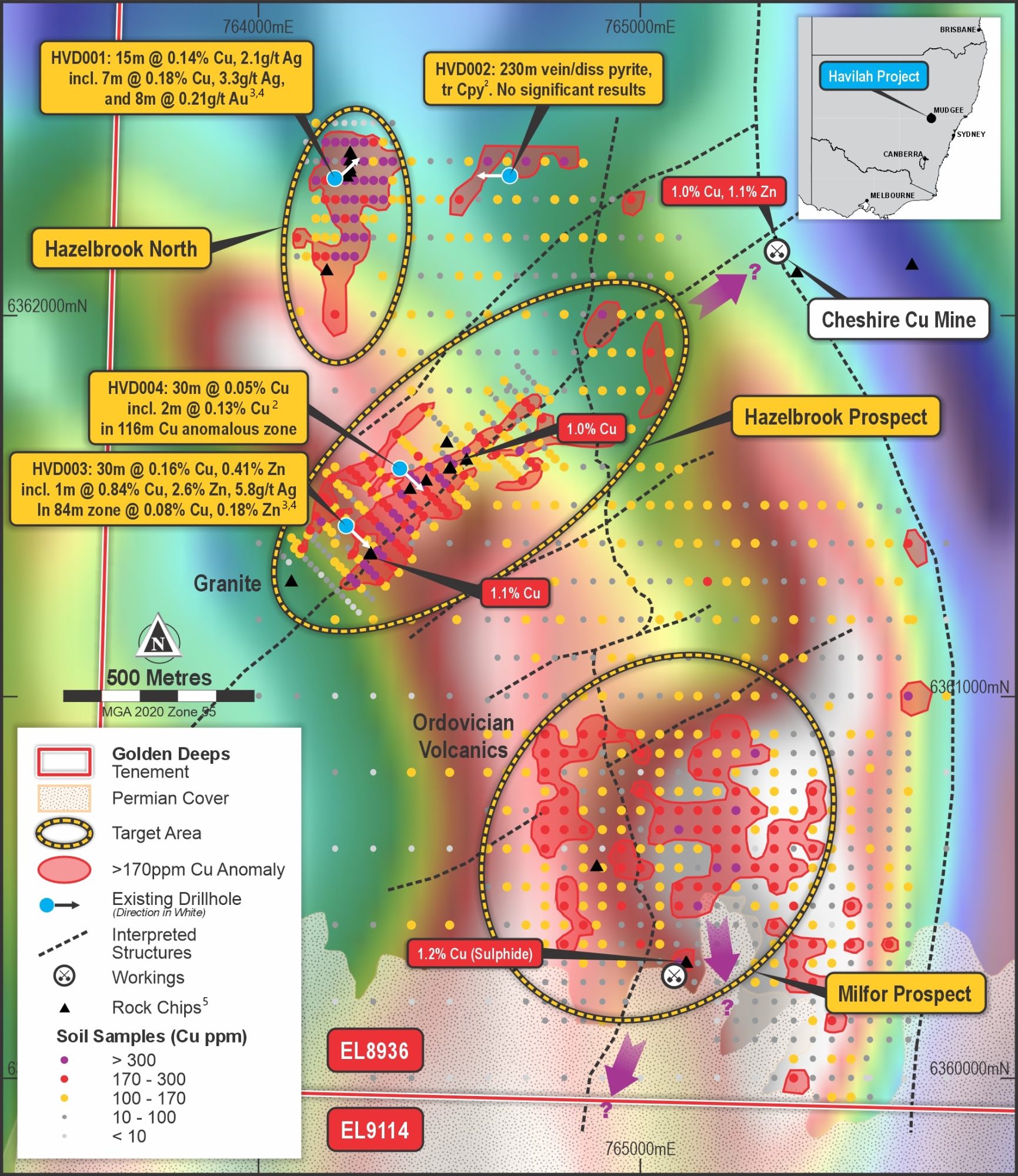
At Havilah, the Company has carried out drill testing of Sofala Volcanics hosted copper mineralisation associated with soil and rockchip geochemical targets and also geophysical targets (magnetics and/or induced polarisation (IP) geophysics). Copper-zinc and silver bearing sulphide mineralisation was intersected at two prospect areas, Hazelbrook and Hazelbrook North (see Figure 3).
At the Hazelbrook target, two diamond holes, HVD003 and HVD004, tested a northeast trending copper-zinc soil and rockchip anomaly in the targeted Sofala Volcanics. Diamond drillhole HVD003 intersected an 84m sulphide bearing zone in the targeted Sofala Volcanics and included a 30m zone with variably developed patches of chalcopyrite (Cu) and sphalerite (Zn). Results from HVD003 included 30m @ 0.16% Cu, 0.41% Zn, 1.0 g/t Ag from 84m including 6m @ 0.30% Cu, 0.72% Zn, 1.8 g/t Ag and 1m @ 0.84% Cu, 2.6% Zn, 5.8 g/t Ag from 102m (see Figure 3).
At the Hazelbrook North Target diamond hole HVD001, which tested the Hazelbrook North Cu-Zn-Au soil anomaly, intersected a 40m zone of siliceous veining with disseminated sulphide mineralisation from surface, across the contact between the Silurian volcanic rocks and the underlying Sofala volcanics. Results from this hole included 15m @ 0.14% Cu, 0.07% Zn, 2.1g/t Ag from 11m including 7m @ 0.18% Cu, 0.07% Zn, 3.3 g/t Ag from 19m. HVD001 also intersected a zone of gold mineralisation, associated with alteration and fine sulphides on the upper contact zone of the Ordovician volcanics. Results included 8m @ 0.21g/t Au from 57m including 2m @ 0.35 g/t Au from 60m in HVD0013 (see Figure 3).
The drilling has demonstrated that extensive sulphide bearing zones are present in the altered volcanics at the Havilah Project, with highly anomalous intersections of copper and zinc (+/- Ag, Au) at Hazelbrook and Hazelbrook North (see Figure AA). Results to date will be reviewed before any further work is proposed.
A third copper-zinc soil anomaly has been defined at the Milfor prospect over a 1km x 1km area (>170ppm Cu)(Figure 3). Previous rockchip results from copper (chalcopyrite and malachite) mineralisation at the southern end of the Milfor prospect produced assays of up to 1.1% Cu. The Milfor copper-zinc anomaly is associated with a large magnetic high – indicative of altered Sofala volcanics, which continues under (Permian) cover to the south of EL8936 (see Figure 1).
Field assessment of the Milfor soil anomaly identified extensive altered volcanics and intrusive felsic dykes associated with the highly anomalous copper in soil results. However, at this stage, a specific drilling target has not yet been defined. Further examination of magnetics, gravity and IP survey imagery/models will be carried out to refine targets in this area.
Acros-Crown JV
The Acros and Crown JV tenements (GED earning 80% interest include five granted and highly-prospective exploration licences adjoining GED’s current projects in the Lachlan Fold Belt Cu-Au Province, NSW.
Targets within the Acros (EL9114, EL9069 & EL9118) and Crown (EL9060) tenements include:
- Extensions of the Sofala Volcanics south of GED’s Havilah Project. Magnetics indicate continuity of the highly-prospective volcanics and intrusives which project south under Permian cover into EL9114 (Figures 2 & 3). No previous work has tested the underlying volcanics and/or the intrusive boundary.
- Extensions of the Rockley-Gulgong belt along the Mudgee Fault (Figure 2), which includes the mineralised Sofala Volcanics and buried porphyry intrusion targets, which extend into EL9069 and EL9060, north of the Havilah tenement.
- Extensions of the Hargreaves / Hill End gold corridor (>2Moz of historical gold production). The high-grade gold corridor extends to the north of GED’s Tuckers Hill prospect, into Acros EL9118.
The Company will build on previous work which has shown that the mineralised Sofala Volcanics and porphyry Cu-Au targets are present on EL9114 and EL9069. Planned work includes further geophysical surveys (detailed gravity, magnetics & IP), with a focus on extensions of the Rockley-Gulgong belt south and north of the Company’s current drilling targets on the Havilah Project (see Figure 2).
This work will aim to define drilling targets for major porphyry/volcanics hosted copper-gold deposits in an area which has received limited exploration due to shallow cover.
Tuckers Hill Gold Project
The Tuckers Hill Project (EL9014) is located ~20km southwest of the town of Mudgee in New South Wales (Figure 1).
The Tuckers Hill tenement is located in the Hill End Trough sedimentary basin and covers projected extensions of the Hill-End – Hargreaves and Tuckers Hill gold mineralised corridors (Figure 1). The Hill End goldfield produced approximately two million ounces of gold from orogenic quartz-vein hosted deposits within folded Devonian-aged sediments of the Hill End Trough.
Golden Deeps’ EL9014 tenement includes the Tucker Hill gold prospect, where stacked high-grade gold bearing quartz veins are targeted. The Tuckers Hill project is at the northern end of Vertex Minerals Ltd’s (ASX:VTX) Hill End Gold Project which has a Mineral Resource of 4.21Mt at 3.6 g/t Au (483,000oz contained gold).
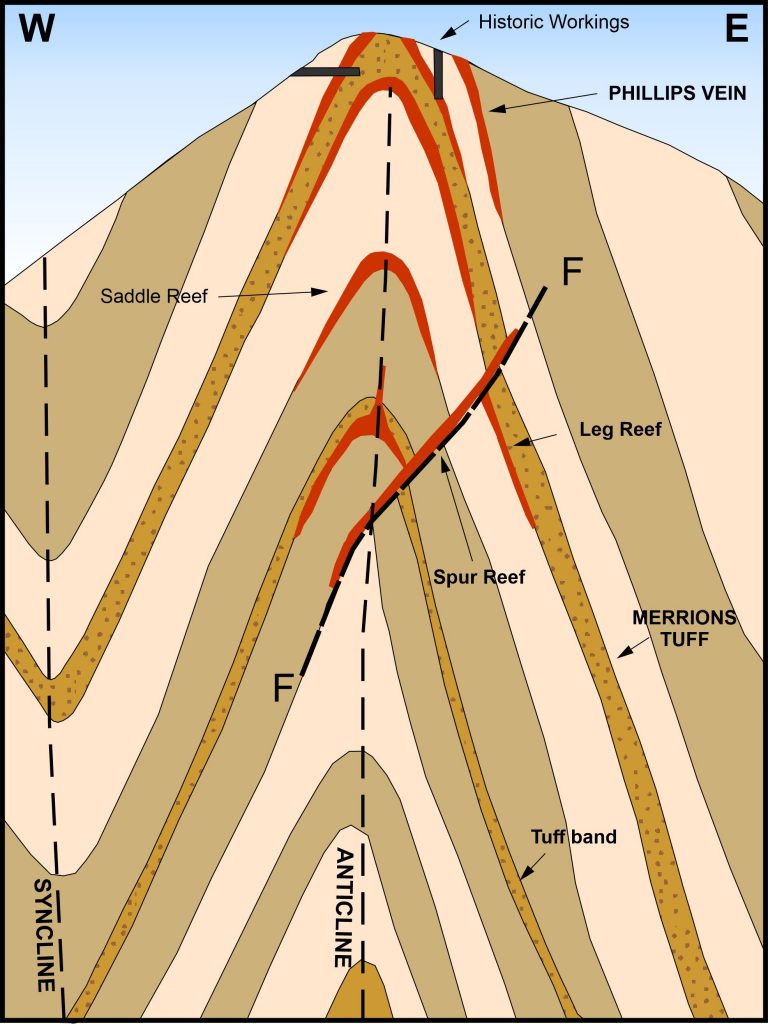
Previous geological mapping at Tuckers Hill has identified gold bearing saddle reefs and ‘leg’ reefs in a folded sequence of siltstone (slate) with minor sandstone, including a prominent volcaniclastic sandstone (Merrions Tuff). Tuckers Hill is an elongate north-northwest trending anticline that plunges to the north and south. Multiple saddle reefs have formed in the apex of the fold at the top of Tuckers Hill with narrow but high-grade ‘leg’ reefs on bedding contacts on the fold limbs (see Image 1 below).
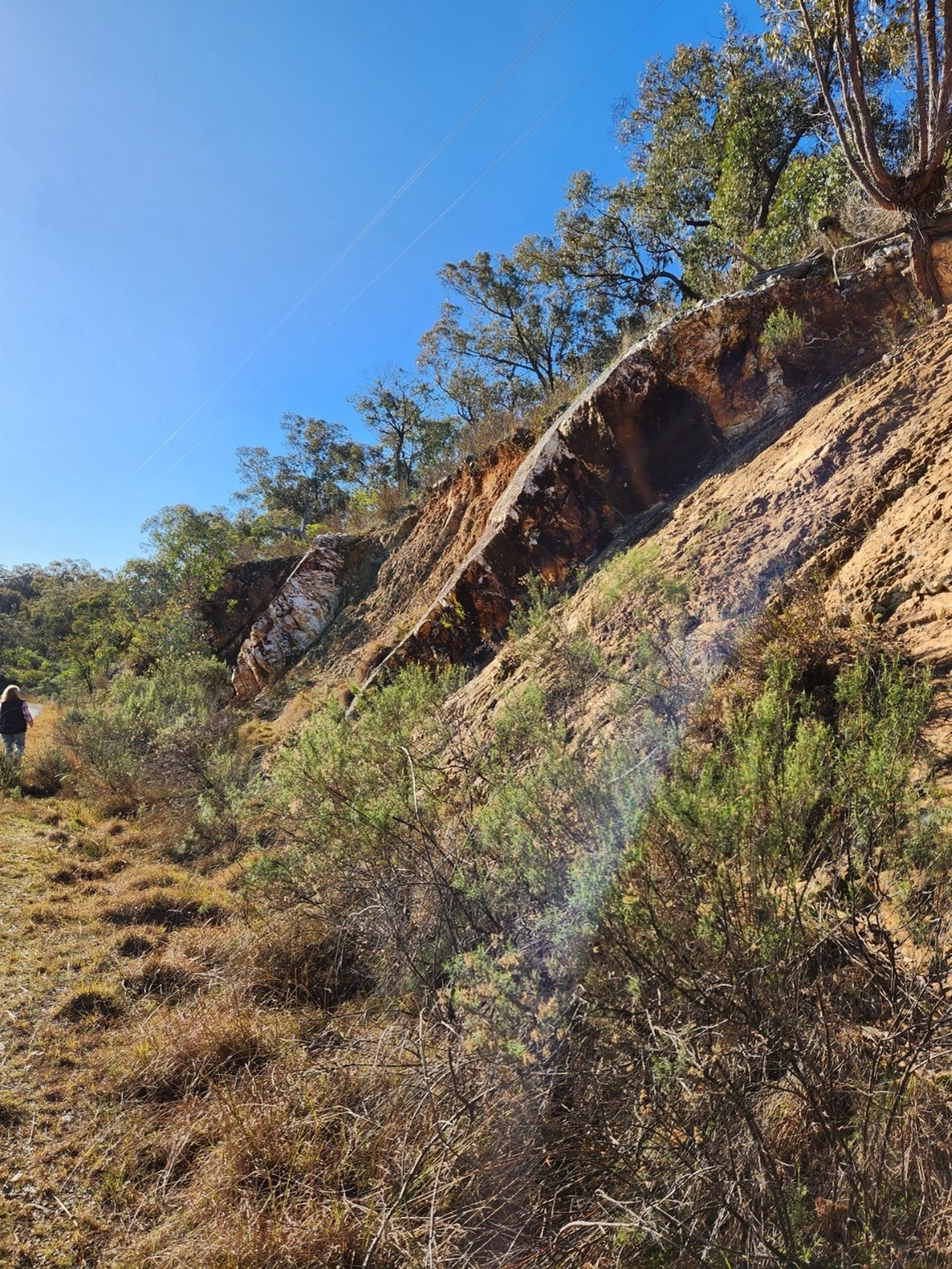
The Company completed Heritage and flora and fauna surveys over planned drillhole locations to test for saddle and leg reefs below Tuckers Hill (see Figure 4). Drilling will target the reefs down plunge to the north of the workings at the top of the hill which are on a series of parallel, high-grade gold veins with multiple assays over 1 g/t Au with a peak value of 28 g/t Au from sampling in 1980s.